


Brood breaks and Varroa control
Updated: Dec 14, 2025
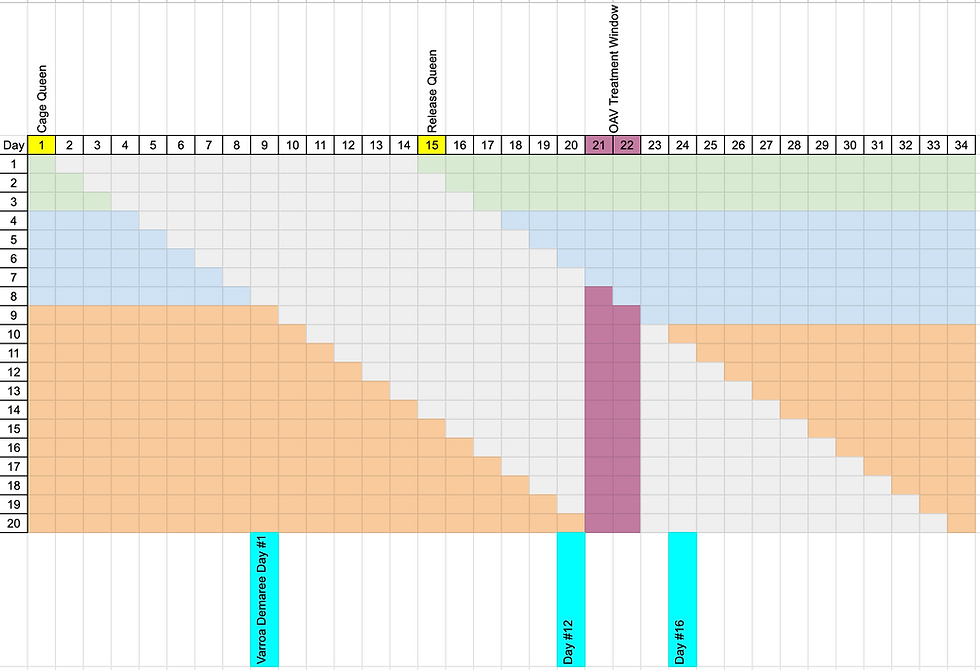
The table below shows brood development and the impact of queen isolation (so she cannot lay).
Green cells are eggs
Blue cells are larvae
Orange cells are capped brood
The chart is based on the worker lifecycle (21 days from egg to emergence). Obviously drone brood is slightly longer under cell cappings (24 days to emergence).
The yellow cells up in the top row indicate when queen is isolated (day #1) and released (day #15). We are assuming the queen immediately begins to lay when released, though this may not always be the case.
The purple columns indicate the optimum time for treatment ie. where all mites (vast majority at least) are on bees (phoretic) and therefore exposed to treatment as there is no capped brood in the hive.
Note: Only 2 days are highlighted, but the window for treatment may extend to 3 or 4 days depending on how quickly the queen commences laying after release. Conservatively, the 2 highlighted days provide the minimum optimum treatment window.
During that short window, any treatment applied to the colony will have maximum efficacy because mites have no cappings under which they can hide. A non-synthetic treatment such as oxalic acid vaporisation could be used to significantly reduce the mite load (95%+ efficacy), and follow with an extended release treatment of some kind to keep mite numbers down for longer.
All up this gives a 2 week brood break which will slow down the colony, causing a population drop as older foraging bees age out before the new worker generations emerge. This eliminates the breeding ground for mites, reduces the overall size of the population, which can help to prevent swarming impulse.
Some considerations need to be kept in mind:
Caging / isolating a queen can impact the colony in other ways. If her pheromone is restricted due to poor access to her while caged, the colony may decide to supersede her. It would be advisable to check the colony for supersedure cells on day #7 or #8, and remove any present.
Per #1 above, it is advisable to use a cage that provides food access to the queen. Queen transport cages, like JZBZ and other brands, may not provide sufficient access. There are some better options that give the queen more space, and enable nurse bees to move in and out of the cage ie the Scalvini cage.
An alternative to queen caging is to either remove or kill the queen (and requeen on day 15) or move the queen into a fully or nearly fully capped super over a queen excluder until day 15 (see video linked below where Dr Berry discusses this approach).
Isolating the queen and inducing a brood break will reduce bee population and swarm tendencies, however it will also reduce the production of the colony. Be prepared to forego some honey. This may also not be compatible with beekeepers chasing pollination, where the key measure is frames of brood. Perhaps pollination contracts need to change to accommodate this?
This method is reasonably labour-intensive, requiring 4 visits in 4 weeks.
Week 1: The queen needs to be found and isolated
Week 2: Brood check on day 7 or 8 for supersedure cells
Week 3: Queen release on day 15
Week 4: Treatment application on day 21 or 22
References
"Summer Brood Interruption for Vital Honey Bee Colonies" by Aleksandar Uzunov
"Splits and Varroa" by William Hesbach
Dr Lewis Bartlett, Dr Jennifer Berry, Bob Binnie, https://www.youtube.com/watch?v=Ocl9MEkBjRg&t=633s


Comments